
When Houston property owners and commercial developers look for a durable, budget-friendly, and environmentally responsible material for paving, a crushed concrete driveway frequently emerges as the top choice. In the heavy clay soils and wet climate of the Greater Houston Area, establishing a stable, well-draining base is critical for any driving surface. Selecting premium crushed concrete Houston aggregate, also known as recycled concrete aggregate, provides an engineered solution that performs exceptionally well under local conditions.
Before embarking on your next driveway construction or road resurfacing project, understanding the performance characteristics, local installation requirements, and cost drivers is essential. This comprehensive guide outlines the practical pros and cons of using a recycled concrete driveway in Southeast Texas, breaks down key pricing variables, and explains how proper drainage preparation ensures long-term stability.
What is a Recycled Concrete Driveway?
A recycled concrete driveway is constructed using processed concrete debris salvaged from demolition sites, sidewalks, highways, and building foundations. Instead of hauling this material to a landfill, concrete recycling facilities process it through heavy industrial crushers. The crushed material is screened into standardized sizes and cleared of any foreign debris. The resulting aggregate is highly angular, allowing the individual pieces to lock together tightly under compaction. This locking mechanism makes it an outstanding material for driveways, parking lots, farm roads, and heavy-duty commercial base layers across Houston.
The Pros and Cons of a Crushed Concrete Driveway
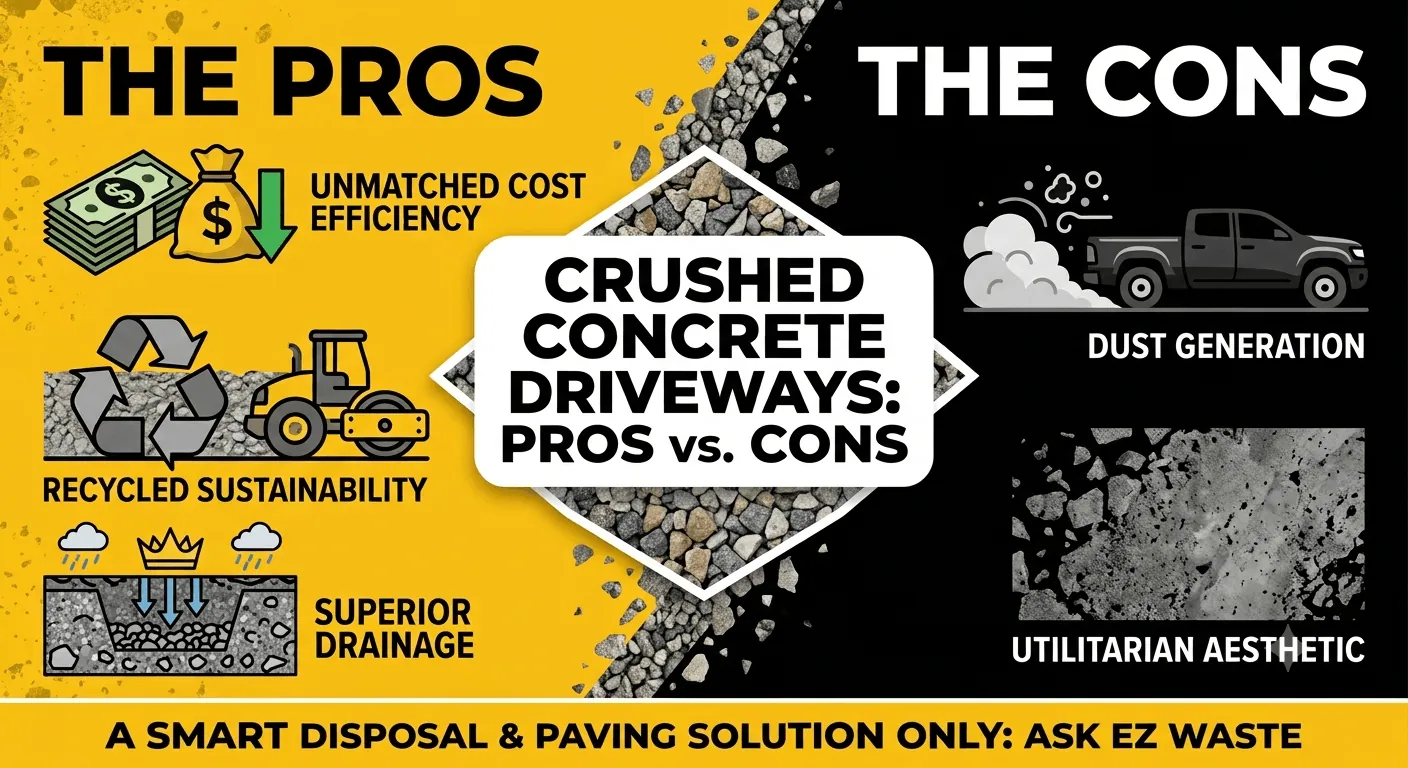
Choosing the right paving material requires weighing the advantages of cost and stability against aesthetics and maintenance. Here is a balanced look at the crushed concrete pros and cons for Houston properties.
The Advantages (Pros)
- Unmatched Cost Efficiency: Crushed concrete is significantly cheaper than quarried virgin limestone, granite, or poured concrete. Selecting recycled materials allows property owners to reduce their initial material expenses by 20% to 40% compared to traditional crushed stone options.
- Excellent Compaction and Stability: Because processed concrete is highly angular, the pieces interlock securely when rolled and compacted. Furthermore, recycled concrete contains residual cement. When exposed to moisture, this cement undergoes secondary hydration, binding the particles together over time to form a semi-solid, pavement-like surface.
- Superior Drainage: Houston is notorious for heavy downpours and flash flooding. A properly graded and installed recycled concrete surface allows water to percolate through the aggregate, minimizing surface runoff, pooling, and erosion.
- Environmental Sustainability: Utilizing recycled concrete keeps thousands of tons of construction debris out of regional landfills. It also reduces the need for heavy mining of natural stone, drastically lowering the carbon footprint of your project.
The Disadvantages (Cons)
- Industrial Aesthetic: While highly functional, crushed concrete does not offer the pristine appearance of natural river gravel or premium marble chips. It has a utilitarian, light grey color. It works beautifully for rural roads, industrial yards, and rustic residential driveways, but it may not match high-end suburban neighborhood guidelines.
- Dust Generation: During dry summer months, traffic over a recycled driveway can generate fine concrete dust. This issue can be managed by applying a top layer of larger washed stone, using a dust suppressant, or opting for 1-1/2 crushed concrete with fines which packs down so tightly that dust is minimized.
- Variability in Mixture: Unlike virgin quarried stone which is highly uniform, recycled concrete can vary slightly in color and composition depending on the source demolition project. Working with an experienced local supplier ensures a clean, thoroughly screened product.
To put the structural capability of this material into perspective, consider this assessment from the Federal Highway Administration regarding the structural integrity of recycled concrete aggregate:
“Recycled concrete aggregate (RCA) is a highly viable alternative to natural aggregate in base and subbase applications. When properly processed and compacted, RCA exhibits mechanical properties, such as shear strength and load-bearing capacity, that often equal or exceed those of conventional quarried stone.”
Key Factors Influencing Crushed Concrete Driveway Cost in Houston
While recycled concrete is highly economical, the total crushed concrete driveway cost is determined by several project-specific factors. Property owners should budget for these primary variables:
1. Material Selection and Volume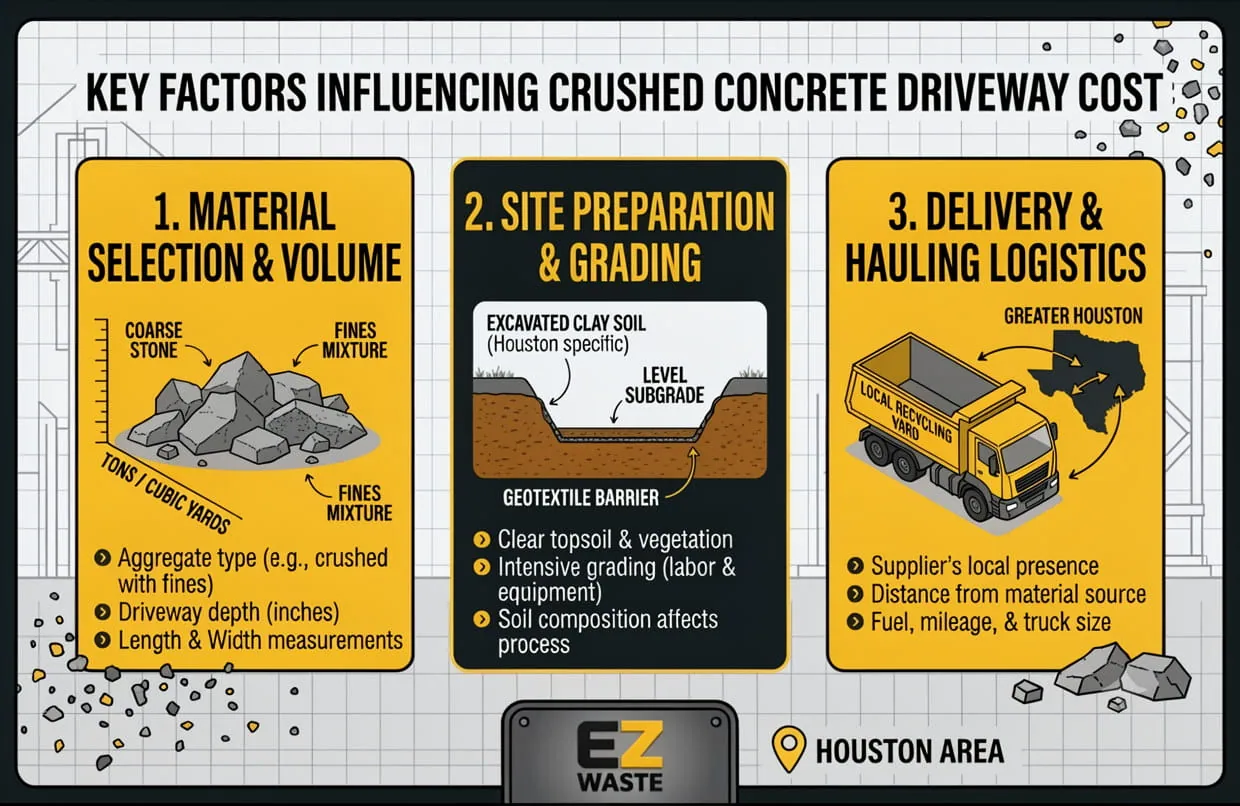

The type of recycled concrete you choose affects the overall cost. For a solid driveway base, engineers typically recommend a mixture that combines larger coarse stone with smaller particles. Materials like crushed concrete with fines are ideal because the small particles fill the voids between the larger rocks, creating a dense and impermeable foundation. The overall volume needed is calculated in tons or cubic yards, determined by the length, width, and depth of your driveway.
2. Site Preparation and Grading
A driveway is only as good as its foundation. In the Houston area, the thick, expansive clay soils must be excavated and graded before any aggregate is laid. Proper site prep involves clearing topsoil, leveling the subgrade, and installing a commercial-grade geotextile weed barrier. This fabric prevents the crushed concrete from sinking into the soft mud below, protecting your investment. Intensive site grading and leveling require specialized equipment and labor, which will impact your total project budget.
3. Delivery and Hauling Logistics
Aggregates are incredibly heavy, and transportation costs play a major role in your final invoice. Sourcing your materials from a local concrete recycling yard reduces the transit distance. Suppliers charge hauling fees based on fuel, mileage, and the size of the truck required. Choosing a supplier with a robust local presence across Greater Houston helps keep delivery fees highly competitive.
Best Practices: Base Preparation and Drainage Solutions
Establishing a reliable driveway in Houston requires addressing the region’s high rainfall and flat topography. Without careful base preparation, a driveway will quickly develop potholes, ruts, and low spots where water collects.
First, excavate the driveway path to a depth of at least 4 to 6 inches. The subgrade must be compacted using a vibrating roller. Next, lay a high-quality geotextile fabric directly over the dirt. This step is non-negotiable in Southeast Texas, as the native clay easily absorbs water and acts like a sponge, swallowing loose gravel if not separated by a barrier. Once the fabric is in place, spread your recycled concrete in uniform layers, compacting each lift thoroughly. To prevent standing water, the finished surface must be graded with a slight crown in the center. This crown forces water to shed off to the sides rather than pooling on the driving surface.
Get Started on Your Paving Project Today
If you are planning a residential or commercial paving project, incorporating recycled concrete is an intelligent way to maximize durability while minimizing expenses. By working with a professional supplier, you ensure that your materials are clean, properly graded, and delivered directly to your job site on schedule. Contact EZ Waste for crushed concrete availability and delivery options throughout the Greater Houston Area.
According to the United States Environmental Protection Agency (EPA), the US generated approximately 600 million tons of construction and demolition debris in 2018. Of this total, concrete accounted for the single largest component by far, with more than 313 million tons successfully recovered and processed into recycled aggregate for next-use applications like road bases and driveways.Data Source: U.S. Environmental Protection Agency (EPA)